Seven Nursing Pad Prints, One Measured Frame
One of these photographs has a number on it. The other six do not. That is the whole reason a first enquiry about reusable nursing pads so often needs a second reply, and it is fixable with something as ordinary as keeping two files apart.
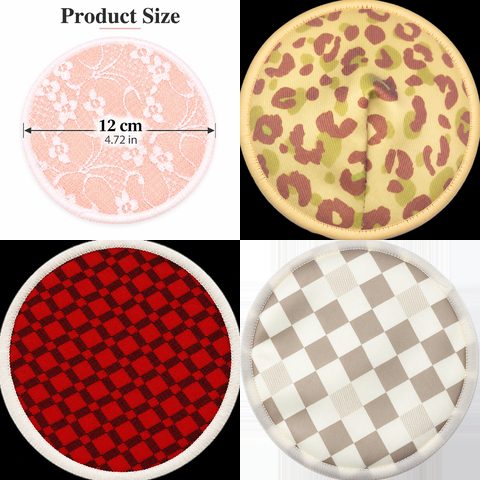
We photographed seven round pads one at a time on a white ground. One frame - pink with white lace flowers - carries a double-headed arrow, a serif heading reading Product Size, and two lines of type: 12 cm and 4.72 in. The other six show prints and nothing else: no arrow, no type, no measurement. If you have ever asked a supplier for a diameter and got another pretty picture back, you know the problem.
What the frame with the arrow is actually saying
The measured frame makes exactly one claim: the pad in that photograph has a diameter of 12 cm, which is 4.72 in. The arrow runs across the widest part of that circle and the number sits beside it. That is all the image contains, and all we will ask it to contain in a caption.
It does not tell you how many layers are inside, name a fabric, give an absorbency figure, state a wash count, or show a certificate. None of those appear in the seven frames. We leave them out because a photograph of a pad face is not where a layer count lives. When a buyer needs the specification, it arrives as its own file, not as a caption under a lace print.
The same boundary applies to the paperwork. A buyer asking which certificates we hold deserves a written answer and a document list, not a tile with a badge drawn on it. Ask for that list in your first message and it goes out as a separate file. We have been making these products ourselves for a long time; that is a reason to answer carefully, not a reason to let a product photograph carry a compliance claim.
The measured frame is also the only one with lettering on it, so it is the one to send for a diameter and the one to keep out of a clean retail tile.
Why six print frames carry no number at all
The six unlabelled frames divide into four families. Two are lace florals: the pink one with the arrow, and a mint green ground with large white roses and a visible fold across the upper half. One is an animal print, a cream yellow ground with brick red and olive leopard spots and a soft seam running from the top edge to the centre. Three are geometric: a red and black buffalo check, an olive and beige zigzag, and a large grey-brown and cream checkerboard. The last is a classic black and cream tartan.
The edging varies too. Most have a white or cream trim; the leopard one is light khaki, and the checkerboard has a noticeably thicker cream trim with the seam visible along the rim. Those differences are real and visible. What we will not do is turn them into a claim about softness or durability that a still image cannot support. If the feel of that thicker trim matters, settle it with a sample in your hand.
Keeping the six frames unlabelled is a filing decision, not an oversight. A print frame answers what the range looks like: which families to open with, which colourways sit together. A size card answers a diameter. Once the two jobs are separated, a buyer can ask for both without working out which photograph is meant to be authoritative. A folder of seven attractive images with no measurement anywhere is not a specification, and a quote built on one is a guess.
None of the seven is a plain pad. Every frame carries a print. If your range needs a solid colour, say so at the start and it becomes a separate question with a separate answer. Pointing at the pale checkerboard and calling it plain is the kind of shortcut that produces the wrong sample a month later.
How to put both cards into one first reply
The useful first message is short. Name the diameter you need, the print family or families you want to look at, and a rough quantity. Those three lines give a supplier enough to answer a quote question without a fourth round of clarification. If you are working from this set, the measured frame reads 12 cm / 4.72 in and belongs to that frame alone; the six print frames are references, not a size chart for all seven.
Ask for samples in the same message, and ask for the measured frame to travel with them. A sample tells you how the trim feels. It cannot tell you which diameter the photograph was taken at. With the full-size frame and the sample side by side, the comparison is like for like, rather than a sample held up against a thumbnail that a messaging app has shrunk and recoloured.
Then ask for the document list as its own file. We would rather send three things in one reply than three replies over three days: what we need in order to quote, how the sample step works, and which frame actually carries a measurement. That is a process choice. It also happens to be what a buyer needs before committing to a first order.
None of this requires a full container to start. A first conversation about two print families and one diameter is a reasonable place to begin. We are not going to put a price, a minimum quantity or a lead time on a public page, because those depend on the order.
If you are building a nursing pad range, send the diameter, the two families you would test first and a rough quantity. We will come back with the measured frame, the print frames, the sample step and the document list in one reply. Seven frames are there to choose from, not to commit to. Visit anandiapers.com or write to us with those three lines.
Q: If I message now, how long until I hear back?
A: One message, one reply. We put the size card and the print card in the same answer so you don't have to ask twice.
Q: What exactly can I change on the product?
A: The photos answer print and binding. The size card answers diameter. Anything past those two we confirm in writing before you plan a range.
Q: Will the second batch look like the photos?
A: Check the sample against the full-size frame, not a thumbnail. We keep the measured frame and the print frames as separate files so the comparison is like for like.
Q: Which certificates do you actually hold?
A: A print photo isn't a certificate. Ask for the document list in your first message and we'll send the paperwork as its own file - no cert claims from a photo.